
If you’re not already aware, I am an aviation enthusiast. I am a private pilot and plane owner. I do my best to try and make the thrill of flying available to as many people as I possibly can. I am an EAA member and a Young Eagle’s Pilot who gives free plane rides to kids at Young Eagle rallys. My favorite plane ride has always been giving someone their very first ride in a general aviation airplane.
As airplanes go, I’ve got a relatively small one. It is a 1967 Piper Cherokee 140. I can carry myself and three small kids, or myself and 2 adults. I’m obviously never going to be able to give everyone a plane ride, so I try to supplement that with video. I have a YouTube Channel that I post a lot of videos on. Almost all of these videos are aviation related.
Today I posted my latest video about how to record flights and what you need to make a great video, hoping that another pilot somewhere could also share aviation with the general public. It’s not exactly the same as flying, but I try to make my videos interesting. If you’re a pilot, this blog post is for you!
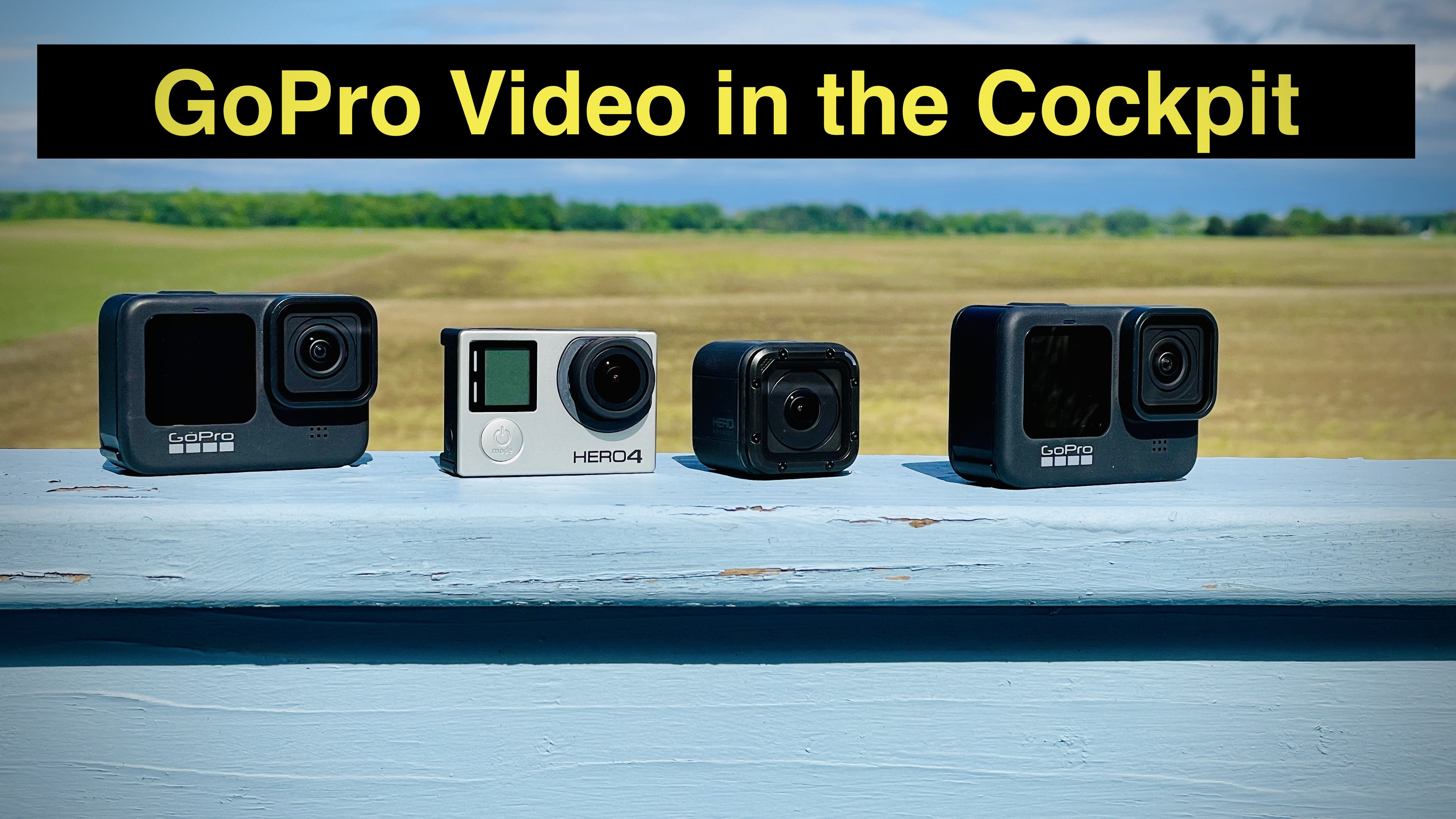
I am partial to using GoPro cameras in the cockpit. They are small, powerful, and produce incredible HD video up to 5K! I own a total of 4 GoPro cameras. I’ve got an older Hero 4 Black, a Session, and 2 new Hero 9 Blacks. GoPro has some good mounting options available, but there are also companies that make mounts specifically for GoPro. My Pilot Pro, and NFlightCam are two that I have purchased and been very happy with. My newly purchased My Pilot Pro GoPro Airplane Mount is rock solid! It is secured to the tail tie down, or wing tie down points with a cam-lock lever. Easy to install and remove. The NFlightCam mounts I bought 6 years ago, and they still work great. The clamshell spud mount, and suction cup are still used almost every time I fly. I would never use a suction cup mount outside the plane. I understand that GoPro and NFlightCam both say that they will hold, but I would rather use a mechanical mount outside. I’m sure no one is going to replace my camera should I lose it.
“Safety is my number one priority”
Randy Broderick
When I decide to record a flight, safety is my number one priority, and I don’t ever want to be fiddling with the cameras in flight. I get my cameras mounted in their specific locations so I can capture multiple camera angles, interesting footage, and good quality audio. Once the cameras are mounted, turned on, and the passengers have boarded, then, and only then, do I start the engine. It’s the “set it and forget it” approach to safe in-flight video.
My GoPro Hero 4 is always mounted on the windscreen in front of me and to the left. I have an audio cable that connects the airplane’s intercom and radio traffic to the camera. It is a must if you want to make really good flying videos with real radio communications. My GoPro Session is mounted either on the tail tie down ring, or the left wing spud. Both positions give a unique perspective. One of my Hero 9’s I mount to the ceiling just over my right shoulder. This gives a great view out the front window, as well as the instrument panel. The Hero 9 has an incredible sensor with out of this world HDR capability. No matter how bright the view out the front wind screen gets, the panel is still not back lit, and completely readable. My other Hero 9 is either mounted on the left side window behind my left shoulder, or to the front windscreen looking forward.
There are of course, lots of other camera options out there, but my personal belief is that GoPro is the industry leader in compact action cameras. Whatever you use, please be safe with the technology when you fly. I would certainly trust the mechanical mounts on the exterior of my plane, to be solid enough to safely and securely hold my cameras.

Do you have any camera, or mounting solutions you like? Maybe some techniques that I’ve not discussed in this post? Please leave me a comment either here, or on my YouTube video linked above.

 Randy Broderick